
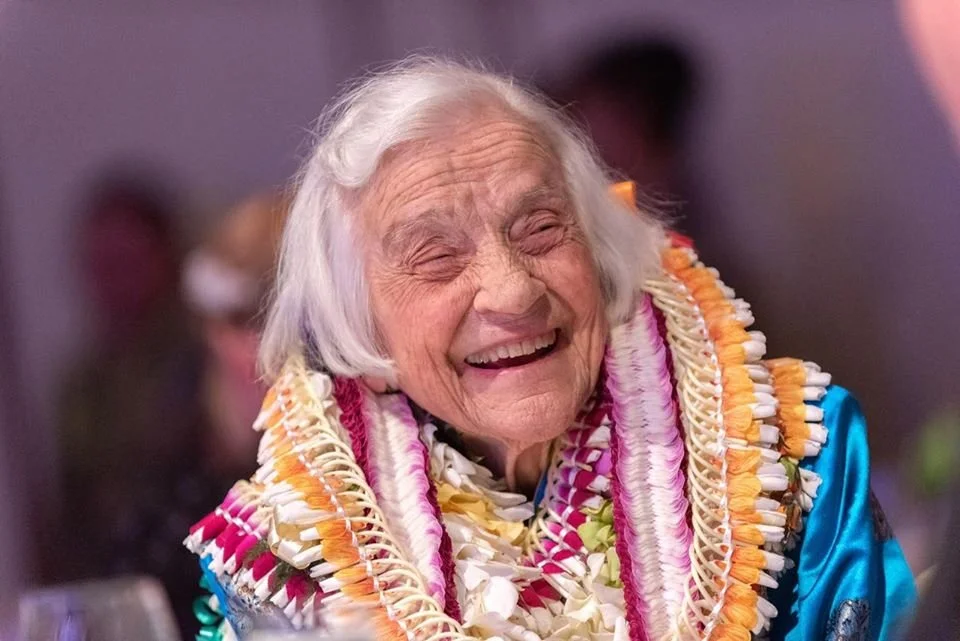
A Legacy of Listening and Learning
A pioneering educator and philanthropist, Barbara B. Smith’s commitment to students and the arts continues to resonate.
PROFESSOR BARBARA B. SMITH DID NOT SEEK RECOGNITION. SHE SOUGHT UNDERSTANDING. For more than half a century, she helped shape the East-West Center through her teaching, her mentorship, and her quiet but transformational philanthropy—leaving behind a legacy that continues to resonate in classrooms, performance spaces, and communities across the Pacific.
An accomplished pianist, pioneering ethnomusicologist, and professor at the University of Hawai‘i at Mānoa, Barbara B. Smith was among the earliest advocates for the creation of the East-West Center itself. Long before the Center opened its doors in 1960, she recognized the importance of an institution dedicated to cultural exchange between Asia, the Pacific, and the United States—and worked tirelessly to help make that vision a reality. For Barbara, the Center was never abstract. It was personal, relational, and deeply human.
Those who studied under her remember not only her brilliance, but her care. Ric Trimillos, one of Barbara’s early students who later became a longtime colleague and trusted friend, often reflected that Barbara taught less by lecturing and more by listening. “She often taught by asking,” he recalled—posing careful, pointed questions that guided students toward their own discoveries rather than prescribing conclusions. She believed deeply in preparation, taking time to research a student’s cultural focus before meeting with them, and held herself to the same standards she expected of others.
“She was especially proud of her students’ achievements,” Trimillos noted, “particularly when they became experts in the cultures of smaller or more remote societies.” To Barbara, mentorship did not end at graduation; it extended into lifelong relationships rooted in respect and shared purpose.
Bill Feltz, another former student and collaborator, described her as an “educator par excellence.” She never craved the limelight, he said, but cared deeply about her students’ well-being—sometimes stepping in quietly to help with personal or medical needs. “She cared greatly about her students, their welfare,” Feltz shared, adding that her support often went beyond academics.
Highly disciplined and exacting, Barbara never missed a class or meeting and was known as a stickler for clear writing and correct grammar. Yet beneath that rigor was a profound generosity of spirit. “She emphasized the value of authentic and historic genres,” Feltz said, “as opposed to ‘showy’ presentations—but she always welcomed thoughtful innovation.” Long before they were widely recognized, she championed Hawaiian performance traditions, insisting that mele, hula, oli, and ‘Ōlelo Hawai‘i were essential to the Center’s cultural and educational mission.
That philosophy informed her philanthropy, with its impact continuing to grow five years after her passing. Through the Barbara B. Smith Endowment for the East-West Center Arts Program, she ensured that the performing arts would remain a vital educational tool at EWC. The endowment has supported artist residencies, performances, lectures, workshops, and community outreach—bringing artists from across Asia and the Pacific into meaningful dialogue with students and community audiences.
EWC Arts Program Manager Eric Chang has spoken of Barbara’s enduring influence on the program’s ethos. Her belief that music, dance, clothing, and ritual are inseparable resonates with the EWC arts program and its grounding in context, integrity, and connection. Thanks to her support, generations have encountered cultural traditions not as spectacle, but as living expressions of identity and history.
Barbara’s legacy also extends powerfully into her connection with Micronesia as one of its first researchers. Deeply aware of the historical and ongoing US connection to Micronesia, her commitment lives on through an endowment administered by the EWC’s Pacific Islands Development Program.